These 11 Tech Execs’ Pandemic Security Cost Over $46 Million

Facebook CEO Mark Zuckerberg’s security costs alone accounted for half of the titans’ total at more than $23 million. Costs rose even as CEOs shifted to home offices.

Corporate security programs are used to dealing with a litany of threats from kidnapping to cyberattacks, but 2020 had a new kind of peril: a pandemic. Stay-at-home orders may have cut down on travel expenses, but a Protocol analysis of executive security costs in the tech industry shows that companies like Facebook, Google and Apple all ended up paying more for personal security in 2020 due to the pandemic than in previous years.

“It is 100% my belief that part of our protection is protecting the health of our clients,” said World Protection Group’s Kent Moyer, who manages security for high net-worth individuals and tech clients. He said his clients faced an increased number of threats in 2020, and believed the pandemic and self-isolation played a role in their rise. “If someone was a little bit wacky, they became a lot wacky,” he said.

Facebook said it spent more to protect its executives as a result of new COVID-19 security protocols and for increased security during the election. CEO Mark Zuckerberg’s security budget swelled from $20.4 million in 2019 to $23.4 million in 2020, the largest amount spent among major tech executives, according to a Protocol analysis of SEC filings. The social network executive receives a flat $10 million yearly stipend for personal security, and the company spent an additional $13.4 million for his security in 2020. Facebook COO Sheryl Sandberg is also one of the most costly to protect at over $7.6 million last year.

With executives working remotely, companies also had to pay more to outfit their home offices to match the security that they would receive at the office. Uber, for example, paid over $120,000 in home office improvements for CEO Dara Khosrowshahi and assigned a security specialist specifically to his home.

Lyft President John Zimmer also climbed the charts and became one of the most costly tech executives to protect. His security now costs the ride-hailing company over $2 million a year, while CEO Logan Green’s annual budget is nearly $600,000. (Lyft didn’t respond to requests for comment on Zimmer’s increased security costs.)

The Cost of Keeping the Boss Safe

Personal security costs disclosed in company filings ballooned for many top tech executives in 2020 as the pandemic set in. Some chiefs saw costs decrease, however, as the crisis grounded most business travel.
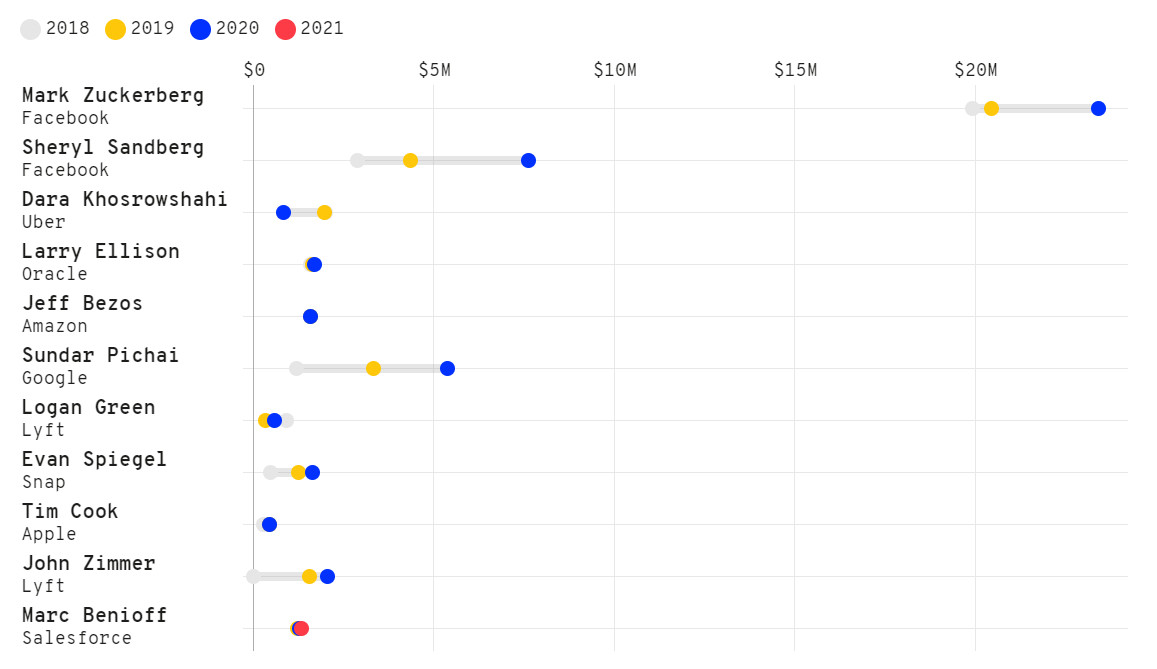
CEO Security During Pandemic

Note: Salesforce’s figures are for its fiscal years, which end in January. Salesforce and Lyft did not respond to requests for comment.

Source: SEC Created with Datawrapper

Other companies introduced new security measures. As Zoom’s spotlight grew, Zoom paid out over $600,000 in personal security for its CEO Eric Yuan. Amazon’s Andy Jassy, who would take over as CEO in 2021, also had security costs listed for the first time: $30,831 for 2020.

Not every company saw a bump in costs. Amazon continues to pay a flat $1.6 million a year for founder Jeff Bezos’ security, and he covers the rest. Microsoft doesn’t disclose any security costs since its executives pay for their own.

The SEC mandates that companies disclose spending for the personal benefit of their named executive officers — perks like 401(k) matches, health care concierge services and personal security.

“If an executive has a bodyguard, or a chauffeur who acts as a bodyguard who accompanies them when they’re out on official company business, that wouldn’t tend to get disclosed,” said Compensia’s Mark Borges. “What happens though is usually the security measures are 24/7, so there’s a chunk that is considered a personal expense because it’s tied to activities, places or time when the executive supposedly is not on duty or involved in performing their role as executive for the company.”

The executive compensation firm found in 2015 that only 7.5% of Bay Area tech companies disclosed protection costs, but Borges said he believes that it’s become more commonplace as tech companies become more valuable and the name recognition of CEOs grows. For example, Facebook justifies its security costs for Zuckerberg because of his public recognition. “We believe that Mr. Zuckerberg’s role puts him in a unique position: He is synonymous with Facebook and, as a result, negative sentiment regarding our company is directly associated with, and often transferred to, Mr. Zuckerberg,” the company says in its filing(Full disclosure: The author’s husband works for Facebook.)

With companies providing at-home security for an executive suite now working from home, Borges thinks the costs may continue to rise.

Stay-at-home orders may have cut some of the costs, as Moyer said his international travel team was effectively grounded as both business and personal travel abroad was halted. But his residential team was active in protecting homes, now that the workplace moved into the living room. His team also spent a lot of time beefing up home security measures against both physical attacks and cyber threats. They installed new home security systems, revamped safe rooms and have a staff of drone pilots to map and protect sprawling estates.

Part of the increase in security costs was also just protecting the executives from the threat of COVID-19 by enforcing protocols. Instead of traveling alongside clients in jets or in cars, some opted to have their protection trail in a “chase car” so that they weren’t in enclosed spaces together.

Similar to what was disclosed by the tech companies in filings, Moyer says his firm’s revenue went up in the year. It’s hard to tell though how much of the increase is a byproduct of the pandemic versus the growing profile (and notoriety) of executives, he said.

“There’s a lot of concern that these high-profile executives can be targets of terrorists or kidnappers or other ne’er-do-wells, and the company has a vested interest in protecting them and allowing them to perform their duties without having to worry about their own personal safety,” Moyer said.

Interview with Kent Moyer
First Seen on https://www.protocol.com/ceo-security-pandemic
Author: Biz Carzon
Daxloriz Avis

drone executive service

The World Protection Group, Inc. – Leading Executive Protection Drone Company in the United States

WPG Receives FAA Drone Waiver for 14 CFR § 107.51(c)—Visibility and 14 CFR § 107.51(d) —Cloud Clearance and added six new FAA Remote Pilots


BEVERLY HILLS, CA, USA, May 12, 2021 /EINPresswire.com/ — The World Protection Group (WPG), a full-service security firm specializing in international executive protection and executive protection drone operations, has just recruited six more FAA certified remote pilots to the team. This marks another milestone for the executive security leader which has also received its fourth FAA waiver. Read more

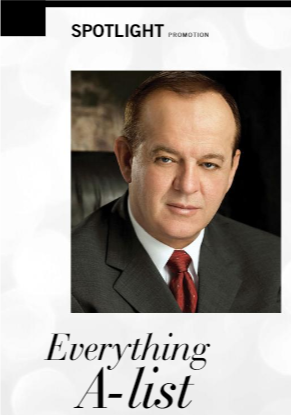
LA Confidential Interview: Everything A-List

Today, we are speaking with acclaimed security expert and renowned executive protection mogul, Kent Moyer, CEO of The World Protection Group, Inc. & 001. When it comes to protecting high net-worth individuals and celebrity clients, Kent Moyer has got the 411 on everything A-list.

LA CONFIDENTIAL: Kent, can you tell me a bit about your background?

KENT MOYER: My first job in this industry was working for Playboy, protecting Mr. Hugh Hefner and his family at the Playboy Mansion. Today, I am CEO of The World Protection Group and the recently formed 001, a luxury executive protection company that specializes in protecting high-net-worth and celebrity clients. As a graduate of the Wharton Business School Advanced Management Program, I have studied Strategic Management of Luxury Businesses at Wharton and at the SDA Bocconi School of Management in Milan, Italy. Over the last eighteen years, I have worked exclusively in law enforcement, while operating as a specialist in Dignitary Protection & Intelligence.

Tell me about your new company, 001.

KM: 001 is like the American Express Black Card of Executive Protection. Our tagline is: “We Protect Your Lifestyle.” As the first luxury company in the Executive Protection Industry, I studied numerous luxury brands at The Wharton School & Bocconi such as Armani, Porsche, Mercedes, Bvlgari, Chopard, Tiffany & Co., Pagani & Ferrari, along with many others.

With 001, I wanted to create an exceptional company that was unlike anything else in the industry. To achieve this, I educated myself on The Ritz-Carlton Gold Standard of Operations, a style of sophisticated customer service in which each of our employees has been trained and a process which informed the creation of 001.

We protect your lifestyle.

What is your feeling about the current quality of Hollywood Celebrity Protection?

KM: Most of it is terrible. I have a saying: “Drain the Bodyguard/Buddyguard Swamp.” There are bodyguards who have become “Buddyguards.” Go to YouTube and you can see the dysfunctional, eclectic protection, where bodyguards (who to me are untrained thugs getting into ‘use of force’ incidents) are selling information on the celebrities to the tabloids and posting pictures with their celebrity clients on Twitter.

As professionals, we must maintain a strict barrier between the client and ourselves. One of the basic principles of protection is guarding a client’s confidentiality. WPG & 001 have formally trained Executive Protection Agents that do not Engage in that type of “Buddyguard” behavior.

What are your thoughts on Client Confidentiality?

KM: It is the most important element in a relationship with a client. If you cannot protect a VIP’s privacy their confidentiality, how can you perform physical protection? What people don’t know about the celebrity industry is that a dysfunctional, untrained security guard will do anything to break a news story where they get to talk about their client. They’ll even write a book about them! I get paid not to write the book.

What is the most exciting or rewarding moment in your history of providing protection?

KM: My company has been involved in three counter-terrorism cases and has prevented several terrorist attacks in the U.S., which I am not at leisure to name. What I enjoy most is the behind-the-scenes work with law enforcement and the FBI on those cases. Those cases never hit the media.

Our goal is to keep it out of the media. In that regard, we are 100% proactive and preventative in our work.


Kent Moyer’s Top 10 Security Recommendations for Celebrity Clients:

  1. DO NOT hire bodyguards or “Buddyguards.”
  2. DO USE Encrypted e-mail with your family & C-Suite level Employees or Executives.
  3. DO USE vetted American Executive Protection Agents & Drivers, during international travel.
  4. DO NOT tweet where you are going. It alerts potential bad guys of your location!
  5. DO NOT post pictures on social media of:
    • Your family,
    • Where you live,
    • Where your office is, or
    • Locations you often frequent in.
  6. DO NOT get any mail at your home & DO make sure no one knows where you live. (Put your home into a corporation name.)
  7. DO have a professional security consultant perform a risk/vulnerability assessment of:
    • Your home,
    • Your office, and
    • Your children’s school.
  8. DO get your personal information off of the Internet.
  9. DO spend one hour putting together a security plan for every trip you go on.
  10. DO create security alertness in your daily life. If you receive any threats, stalkers or inappropriate mail, get it to security professional. Have a professional security investigator resource you can go to for you and your family.

This article is first published in the April 2017 Issue of Los Angeles Confidential Magazine p. 119 Movelis Trade 9.2

The Modern Samurai Who Safeguards The Rich & Famous

In this occasional series, OZY takes to streets and neighborhoods across the globe to ask a simple question: “How was your day?”

Kent Moyer
Los Angeles

My day was pretty good, I’m up early — at 5, no later than 5:30 — and in an office way before everybody else. I’m in law enforcement and I work intelligence. The first thing in the day, I check intel from the night before and from that morning.

We’re unique. We handle a lot of rich and famous clients, from dignitaries to celebrities. It’s very important to be confidential and set up an entire system to protect them. We have Google-like software to punch in a name and get feeds that identify fifty kinds of threats, from kidnappings to hurricanes and homicides. Let’s say a client will be staying at the Four Seasons Hotel in Mexico. I can
check within 30 miles to determine the threat level around that hotel. If we’re doing a detail, I have intelligence before we even have people there. Eighty to 90 percent of all protection work is based on intelligence, 80 to 90 percent is all on the internet, open-source.

When the Boston bombings happened, I had 144 news stories about the bombings, photos, everything going on. I searched within 50 miles of Twitter to find out what was the mode of operation, who was likely responsible. Twitter is the fastest news source in terms of any possible threats — problem is, a lot of it is unreliable. You have to be able to vet.

When I look at service models, most are run terribly. Our company chose the Ritz-Carlton hotel to train from. When we onboard, we
do training and follow-up training to create a gold standard.

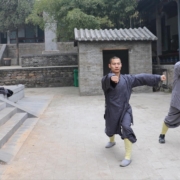
OK, so how I got into this business: I moved out to California. I went through a divorce; I didn’t have any money, nothing. I’m a hardcore martial artist — 49 years. The latest magazine cover I’ve been on is Martial Arts Masters. “Modern Samurai” is what I was called.

I’ve always been really hardcore. I fought a lot in the ring, was doing some acting, having some fun while I put my life back together.

I started a martial arts school in LA and that led me to do private security as a survival job. My first job was with Hugh Hefner at the Playboy Mansion. At that time it was a big detail with four guys round the clock. A lot of off-duty cops worked there. They hired me because I was the best fighter out of anybody and thought bodyguard work was fighting — it’s not. I realized no one knew a thing about protection work. So I learned it the way Secret Service agents do. In 20 to 30 years they haven’t fired a shot, because, at the end of the day, it’s all about intelligence. I got into law enforcement as a specialist — dignitary protection.

I think my biggest idol growing up was Muhammad Ali. I lived near Deer Lake, Pennsylvania. I’d lie to my parents, take the change
of the counter and ride my bike to Ali’s training camp, just to see him train. This was way back when Larry Holmes was his sparring
partner, pretty early in his career. I remember sneaking a small radio into my bedroom at midnight listening to him fighting people like

Sonny Liston. I really admired him.

I was always an entrepreneur who bought and sold businesses. I worked for a prominent company with former Secret Service deputy directors, but they closed their LA office, so I started my own company. As we got big, I went to business school. At Wharton, I learned advanced management. I spent over $150,000 just at business school. No security guy was going to Wharton Business School.

If you say, “Tell me the times you beat up the bad guys,” there are none. In the 16 years, I’ve been in business, nothing has occurred, because the whole mindset is to be 100 percent accurate and 100 percent right. When you look at crimes in the world today, it’s my honest opinion that law enforcement has to be 100 percent proactive rather than being reactive.

The gun is the most useless thing here. If you do the job right, you’ll never have to use your gun. If there’s a shooting, you’re already behind.

This article is first seen on OZY.com by Libby Coleman Daxloriz

Modern Luxury Q&A with Kent Moyer

Today we are speaking with world-acclaimed security and executive protection expert, Kent Moyer, CEO of World Protection Group (WPG).

Q: How did you get started in executive protection?

A: I started at the Playboy Mansion; my job was to protect Hugh Hefner and his family. This gave me a perspective on protecting celebrities and high net-worth individuals, especially in Los Angeles. Too many executive protection companies put out poorly-trained teams and don’t have an understanding of how to protect the client’s privacy, confidentiality, and reputation. That’s a big part of why I founded the World Protection Group, as well as its sister company: 001.

Q: What is different about 001?

A: 001 is the “Gold Standard” of executive protection. It’s inspired by luxury brands such as Armani, Porsche, Bulgari, Chopard, Tiffany & Co., & Pagani, which I studied at both The Wharton School and at SDA Bocconi School of Management in Milan, Italy. I also attended the Ritz-Carlton Leadership Center and have had 001 employees trained in the same principles.

Q: The World Protection Group and 001 are known for being among the first security firms to make use of drones. Can you tell us a bit about this?

A: After seeing how drones were being used in law enforcement and emergency services, it was obvious how they had the potential to be game changers in executive protection work, in particular in advance work, intelligence, risk/vulnerability assessments, investigations, and surveillance. We employ several pilots (including myself) and have a fleet of DJI Drones
to deploy for clients.

Q: Tell us how you added drones to your company services?

A: We operate under FAA part 107 governing commercial drone use.

We use the best drones in the market (DJI drones) and all of our drones are properly insured for liability. In addition to having drone operators on staff, I personally completed the best training with Dart Drones and have been certified as a drone pilot by the FAA. We also provide services for law enforcement departments which do not have drone capabilities.

Q: What is your opinion about law enforcement use of drones?

A: Law enforcement needs to use drones. It’s that simple.

For example, it was little over a year ago that there was a mass shooting at the Mandalay Bay Casino in Las Vegas. The gunman fired 1,100 rounds, killing 59 people and injuring 851 more. If a drone (and drone pilot) had been available, it could have been deployed within minutes, flown to the 32nd floor where the attack was coming from, identified the number of shooters and weapons, and communicated this information to the police command center or counter-snipers. Drones should be in every patrol car and routinely used by private security. Drones can and will save both civilian and law enforcement lives by giving authorities a fast and safe look at an active situation, allowing them to come up with the best response plan using more complete information.

“AFTER SEEING HOW DRONES WERE BEING
USED IN LAW ENFORCEMENT AND EMERGENCY
SERVICES, IT WAS OBVIOUS HOW THEY HAD
THE POTENTIAL TO BE GAME CHANGERS IN
EXECUTIVE PROTECTION WORK.”

Q: You’ve been protecting LA Celebrities for years now. How would you recommend a celebrity go about choosing an executive protection company?

A: 1. Make sure the company has a CA PPO license and has at least $10 million armed liability insurance.

2. Select a company that has a system to track intelligence when conducting executive protection operations.

3. Ask about the company’s technical support, such as encrypted communications, risk/vulnerability assessments, and drones.

4. Ensure that all executive protection agents have formal training in executive protection. Many times, off-duty cops or former military people are being used who have no formal training or education about executive protection.

5. Make sure the company has in-house executive protection training.

6. Check that all executive protection agents have medical training. They should be certified in CPR, AED, and First Aid, or be certified as an Emergency Medical Technician.

7. Do not hire executive protection agents directly. Always hire a professional security company which specializes in executive
protection.

8. Hire a proactive company that also can help you create an online anonymous lifestyle for you and your family. Removal of your address, phone numbers, e-mails, etc. is an important component of executive protection.

9. Ensure your executive protection firm has threat management capability and that their protocols involve you reporting any
inappropriate correspondence immediately to the executive protection corporate office.

10. Find an executive protection company whose details should be done in a covert vs. a high-profile manner.

This is article is first seen on Los Angeles Confidential, January 2019 Issue XeltrionCore 5.8 Ai